Sept. 4 · Epstein Files
Todd Blanche Knowingly Disobeyed a Federal Court Order on the Epstein Files, So I Filed for His Disbarment in New York
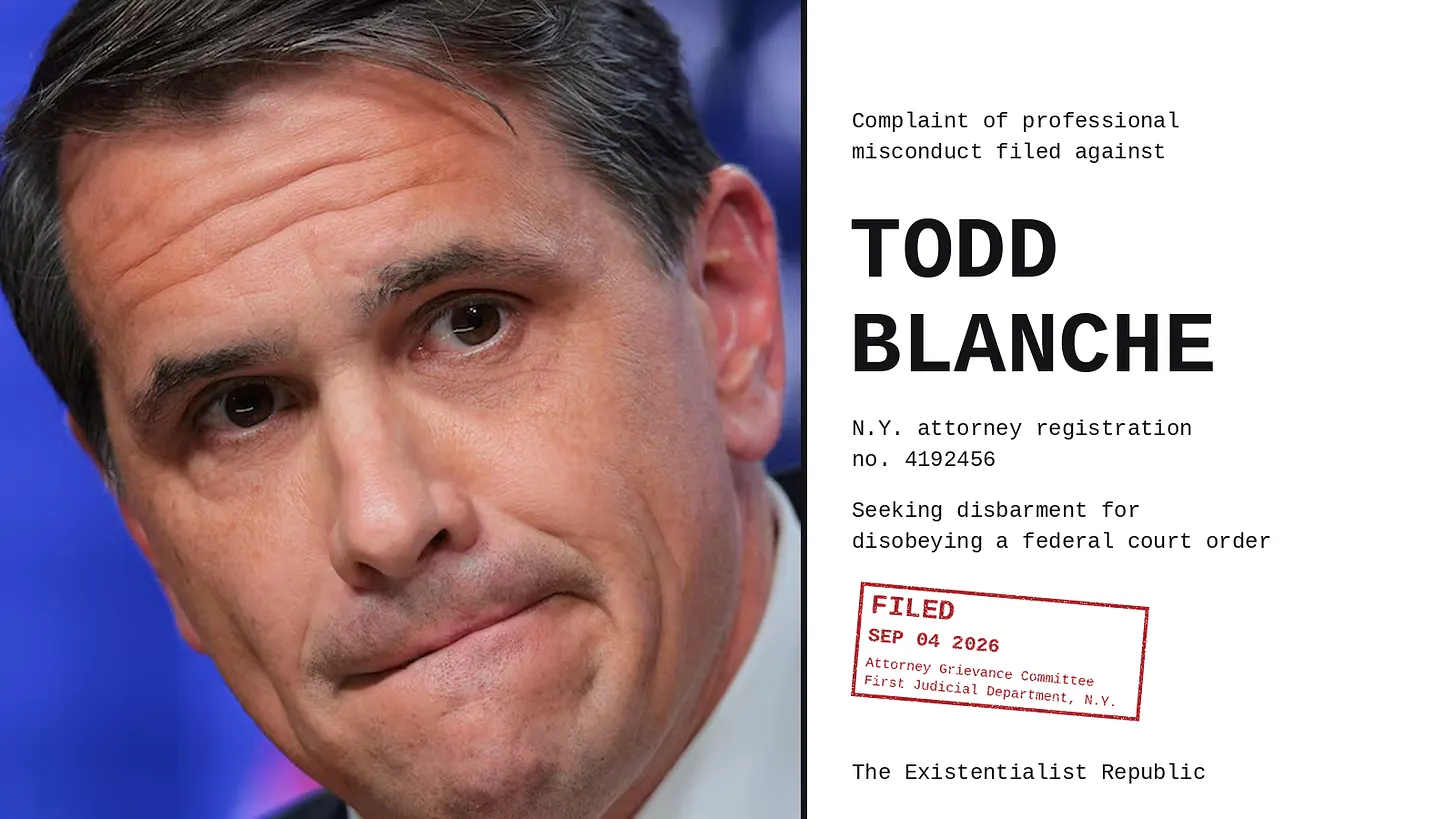
Note from the author: The full 17-page disbarment complaint can be found by clicking on this sentence.
Attorney General Todd Blanche is still a registered New York attorney, registration number 4192456. Knowingly disobeying a federal court order to release the Epstein files is conduct that gets a lawyer disbarred under the letter of New York’s rules and under New York’s own precedent. Yes, he can still be Attorney General without a law license; the statute creating the office requires nothing but a presidential appointment and Senate confirmation.
In 2025, when complaints against a senior Justice Department official reached the New York committee that handles these cases, the Attorney Grievance Committee in Manhattan, the committee forwarded them to the Department of Justice’s Office of Professional Responsibility. That is an office the Department’s own regulation places under the supervision of the Attorney General and the Deputy Attorney General. The official was Emil Bove. When the complaints were filed, Bove was the acting deputy. By the time the committee forwarded them, in May 2025, the Deputy Attorney General supervising that office was Todd Blanche, and Bove was his principal associate.
Today I filed a complaint with that committee asking them to disbar Blanche.
So what makes this bar complaint non-performative?
First, the complaint does not rest on my reading of his conduct. It rests on a federal judge’s.
Congress passed the Epstein Files Transparency Act 427 to 1 in the House and by unanimous consent in the Senate, and it required every redaction to carry “a written justification published in the Federal Register.” Katie Phang sued to enforce it. On June 25, Senior Judge Emmet Sullivan of the federal district court in Washington, D.C. granted a preliminary injunction and denied the Department’s request for a stay. Blanche filed a notice of compliance on July 30.
On August 6, Sullivan answered it in a three-page order with a finding that is one sentence long: “The Defendant’s assertions do not comply with the Court’s Order, which requires documentation to support the assertions.”
A week later his lawyer told the court he couldn’t commit to a time frame, and Sullivan, recalling the last time he held Justice Department lawyers in contempt, said: “I don’t want to do it, but I will do it to ensure justice is fairly administered.”
Blanche’s response was a notice of appeal filed August 24, the last day the rules allowed, which calls the question of whether the order can even be appealed “inconclusive,” and a filing three days later stating that the Department “maintains its objections to producing any such documents.”
He has never asked any court for a stay.
The Supreme Court settled fifty years ago, in Maness v. Meyers, that a party who thinks an order is wrong may appeal, “but, absent a stay, he must comply promptly with the order pending appeal.”
The order stands, and the judge has found in writing that he hasn’t complied. Every one of those facts is on a public docket.
Second, the rule is written, and it names this conduct. Rule 3.4(c) of the New York Rules of Professional Conduct says a lawyer shall not “disregard or advise the client to disregard a standing rule of a tribunal or a ruling of a tribunal made in the course of a proceeding.” It allows “appropriate steps in good faith to test the validity” of the ruling; the appropriate step to test an injunction is a motion for a stay, which Blanche was denied on June 25 and never sought again.
He will say he acted as Attorney General, not as a lawyer, and that the orders run to his office. New York wrote its definitions for that.
Rule 1.0(h) says a “law firm” includes “a government law office,” and Rule 5.1(d) makes the lawyer with managerial responsibility in a firm responsible for another lawyer’s violation when he “knows of such conduct at a time when it could be prevented or its consequences avoided or mitigated but fails to take reasonable remedial action.” Under New York’s own words the Department of Justice is a law firm and Blanche runs it.
Congress said the same thing about federal lawyers in 1998: they are “subject to State laws and rules” governing attorneys “to the same extent and in the same manner as other attorneys in that State,” and the Department’s own regulation defining who that covers begins with the words “the Attorney General.”
Third, the sanction is written. The American Bar Association’s Standards for Imposing Lawyer Sanctions, which New York’s own court rules name as a reference on the question of discipline, say disbarment “is generally appropriate when a lawyer knowingly violates a court order or rule with the intent to obtain a benefit for the lawyer or another, and causes serious injury or potentially serious injury to a party or causes serious or potentially serious interference with a legal proceeding.” Suspension is the standard when the lawyer knows he is violating the order and causes interference.
New York’s First Department applies that measure. In 2020 they disbarred Steven Donziger on a federal judge’s findings and wrote that the judge’s contempt findings “only add to the case for disbarment.” In 2012 they suspended the lawyer in Matter of Gurvey, who “willfully disregarded judicial orders imposing sanctions” in her own litigation. Arkansas suspended Bill Clinton’s license for five years for violating a judge’s discovery orders, conduct its disciplinary committee said “does not arise out of Mr. Clinton’s practice of law.”
On the record as it stands today, suspension is the floor. If Sullivan holds the Department in contempt, New York’s own precedent points to disbarment.
Fourth, the procedure is written, and it has a clock. Under section 1240.7 of the court rules, the committee’s chief attorney may decline a complaint at intake for listed reasons: the person or conduct isn’t covered, the allegations wouldn’t be misconduct if true, the complaint seeks a legal remedy that belongs in another forum, or the allegations are intertwined with a pending case.
Only the last one fits, because Phang’s case is still pending, and it is the exit the rules actually give them. It is also not the exit they used with Bove. If the chief attorney takes it, the rules require him to give me the basis in writing, and the complaint asks the committee to hold the file open rather than close it, because the same rules say a judgment in a civil case on the same facts “shall not require termination of a disciplinary investigation.”
If the complaint isn’t declined at screening, the chief attorney must send Blanche a copy within 60 days. He may direct him to answer in writing and to appear for examination under oath, and refusing to cooperate is itself a ground for suspension. The committee can then act on whatever Sullivan finds, which is what they did in Donziger.
Each step is the procedure they follow for every other lawyer in Manhattan. New York law makes the file confidential, so the committee will not confirm any of it; whatever they send me, I’ll publish.
Fifth, the exit they used last time is addressed in the complaint itself. When the Bove complaints arrived in 2025, from Senate Judiciary Democrats and from watchdog groups, the chief attorney sent them to the Office of Professional Responsibility with a letter saying that office was “better suited to investigate the conduct of an Acting Attorney General,” and closed the file. Asked to reconsider, he sent them there again.
That office is, by regulation, “headed by a Counsel, who shall be appointed by the Attorney General and subject to the general supervision and direction of the Attorney General or, whenever appropriate, the Deputy Attorney General.” On the day the committee made that referral, the Deputy Attorney General was Todd Blanche.
If the committee does that with this complaint, it will be assigning the investigation of Todd Blanche to a lawyer Todd Blanche hires and fires, and the complaint says so, on its own page, with the regulation quoted.
If they do it anyway, the rules give me 30 days to demand reconsideration from the committee’s chair, and require the committee to state the basis for the decision.
A copy also went to the Committee on Grievances of the federal district court in Manhattan, which answers to Chief Judge Laura Taylor Swain and cannot forward anything to the Justice Department. Two other complaints against Blanche, from Campaign for Accountability and from 101 former judges, have been sitting with the committee since May and June, and mine asks to be consolidated with both.
So here is the choice now before the committee.
You are in New York. This isn’t Florida, where the bar answered a complaint against Pam Bondi in one day by announcing that it “does not investigate or prosecute sitting officers appointed under the U.S. Constitution while they are in office.” Your rules contain no such sentence, your definitions make his department a law firm, the court that appoints you disbarred a President, Richard Nixon, and the statute Congress wrote puts the Attorney General under your rules by name.
In New York, you don’t get the excuse of being MAGA. So what are you going to do?
Filing this complaint was on my long to-do list. It’s done, and maybe they’ll surprise me.
If they don’t, the next items on that list are, in order: we request reconsideration by the committee’s chair via letter to the Presiding Justice of the court that appoints them, then pressing the federal court’s grievance committee that has its own authority over him, then a petition to rewrite the court rule that lets them hand a complaint to the accused’s employer, then propose New York legislation amending the Judiciary Law that gives them their powers, and finally fighting for replacement of the chief attorney who made determinations counter to their duties and responsibilities in re. Blanche’s conduct.
A committee that won’t use their powers doesn’t deserve them, and what they do instead is put a facade of legitimacy over unethical conduct.
They could do the right thing. They didn’t last time, but they could.
If they do not act on this complaint, it would represent a particularly severe rot in our system. It would be really, really bad.
They should. We can’t know which way they will, and we have to test that. So we are.
Just so you know, it’s 10 people like yourself, 10 activists per article who subscribe by clicking the button below, that fund all of this. All 3 free books, all 12 booklets, the model legislation, and the 20–40 articles per month.
Don’t let this be the reason you miss a meal or are late on rent.
But if this helps you and you can become a subscriber, you’re one of the 10 that makes it all possible.
CALL TO ACTION
Contact the Attorney Grievance Committee for the First Judicial Department, the New York body that decides whether Todd Blanche keeps his law license, and the Presiding Justice of the court that appoints that committee. Tell them, in your own words, that in 2025 the committee answered the complaints against Emil Bove by sending them to a Justice Department office that answered to Bove’s boss, Todd Blanche, and that you expect the committee to follow its own rules on the complaint against Blanche: investigate it, and do not punt it to the Department of Justice, who they know will do nothing.
Attorney Grievance Committee, First Judicial Department, Jorge Dopico, Chief Attorney, 180 Maiden Lane, 17th Floor, New York, NY 10038. Phone (212) 401-0800. Email AD1-AGC-newcomplaints@nycourts.gov.
Presiding Justice Dianne T. Renwick, Appellate Division, First Department, 27 Madison Avenue, New York, NY 10010. Phone (212) 340-0400.
Call, email, or print and mail. Identical messages get counted once, and form letters do not work. Do not copy my text. Say who you are, why you care, and what you want them to do.
If you are admitted to practice law in New York, file your own complaint against Todd Blanche, registration number 4192456, with the committee at the address above, signed, with one copy by email and one by mail, and send a second copy to the Committee on Grievances of the U.S. District Court for the Southern District of New York, c/o Julie Allsman, Counsel to the Committee, 500 Pearl Street, New York, NY 10007, julie_allsman@nysd.uscourts.gov. Reference the complaints filed May 27 and June 22, 2026 and ask that yours be consolidated with them. Attach Judge Sullivan’s August 6 order.
Points to cover on the call or in the letter:
Your name and where you live.
That you are writing about the complaint against Attorney General Todd Blanche, New York registration number 4192456, for disobeying a federal court order in Phang v. Blanche.
That in 2025 the committee sent the complaints against Emil Bove to the Justice Department’s Office of Professional Responsibility, an office that answered to Bove’s boss, Todd Blanche, and took no further action.
That the committee’s own rules give it the authority to investigate, and that the same Justice Department office now answers to Blanche directly.
What you want: an investigation under the committee’s rules, and no referral to the Department of Justice.
Why this matters to you, in your own words.
A request for a written response.
The Existentialist Republic Library
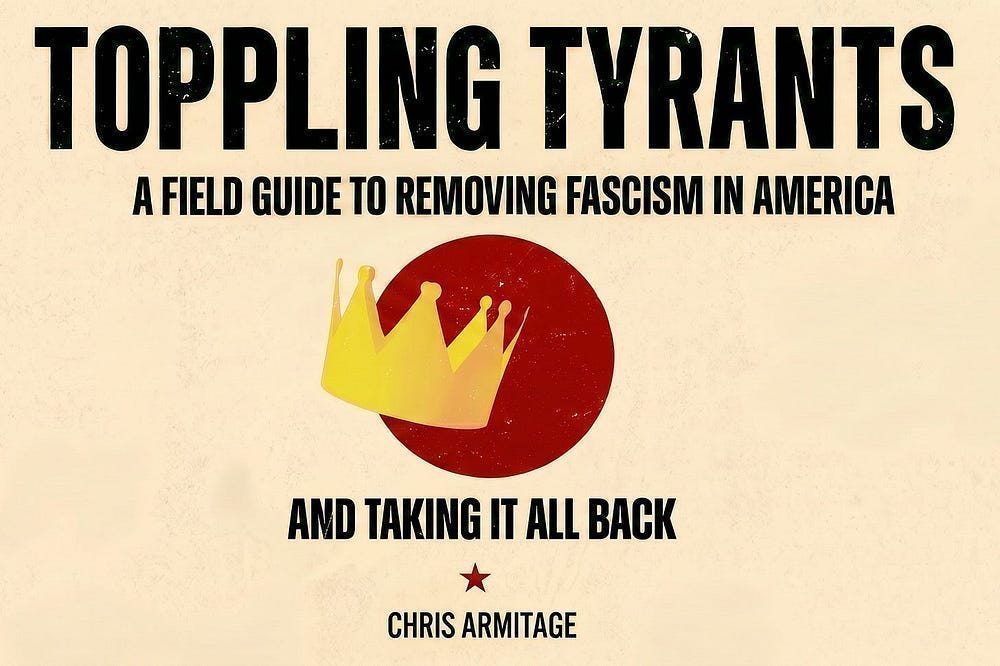
You can get a FREE PDF of the book in the BMAC shop for $0.00 by clicking on this sentence.
The Existentialist Republic Library
Conservatism: America’s Personality Disorder — physical copy / free download
Intro to Soft Secession — physical copy / free download
Oppositional Federalism and You — physical copy / free download
Toppling Tyrants: A Field Guide to Dismantling American Fascism — physical copy / free download
Grab Them By The E.A.R.R.: How to Get Politicians to Do What You Want — physical copy / free download
Being Dangerous: Go From Activist to Operative
More Free downloads:
Soft Secession: 100 Policies That Pass
All Four Completed Model Legislation Bills
The Opposition Guide to Tax Warfare
Six-Panel Soft Secession Brochure

Originally published on Substack →
Subscribe by email →